
SUITES

The rural suite is comprised of dances that originated from the Christian lowlands, specially the region of Luzon and various parts of the Visayan Islands. Re-enacting the lifestyles of Filipinos in these regions, the dances in this suite illustrate the joy of the work and simplicity for those living in the "barangays" or villages.

Dances in Rural all contain a sense of partnership and trust. Partners share an intimate connection, showing both coordination and faith in one another and illustrating the traditional value of family and community. Nevertheless, the dances of Rural embody the lively and vivid side of the Filipino spirit and celebrate the simplest, yet happiest moments in life.

The Kordilyera Suite celebrates the culture of Luzon's mountain tribes. Hailing from the Cordillera mountain region, the suite features dances from the Apayao, Bontoc, Ibaloi, Ifugao, Kalinga, and the Kankana-ey people. The indigenous people of this region passed down their dances through the ages, maintaining custom and tradition despite the forays of Spanish imperialism and modern diaspora.

Dances in this suite celebrate life, commemorate death, and herald war. Courtship dances imitate the graceful movements of birds, while funerary dances evoke "anitos", or ancestral spirits. Community dances might be performed at a wedding or a birth and involve male and female, young and old. In all, the traditional "gangsa" are played, providing percussion counterpoints to the voices and footsteps of the people. Men wear bahags, women wear tapis, brightly colored headbands, and bead necklaces.

The Moro Suite houses dances of both pre-Muslim and Muslim origins from the Moro people of the southern Philippines. The Moros are the largest group of non-Christian people in the Philippines, residing mainly around Mindanao and the Sulu Archipelago. Many tribes make up the Moro people, including the main Maguindanao, Maranao, and Tausug tribes.

The dances in this suite often portray religious rituals, war dances, and stories of royalty. The dancers are adorned in rich, vivid colors along with jewels, swords, and shields. These colors, along with the rhythmic movements, show influence from Arabian and Indo-Malaysian cultures. The dancers carry themselves with a regal pride befitting the Moros' surviving culture.

The Traditionalist Suite represents many of the Lumad tribes in Mindanao. The tribes consist of non-Christian Filipinos whose beliefs predate Islam and Christianity; they believed in various gods of nature. They are influenced with the Southern countries/continents (e.g. China, Indonesia, Malaysia), mainly due with trade/ immigration, but have been untouched by colonization in religious and cultural aspects. The tribes utilized dances to portray their everyday life and to story-tell.


The Maria Clara suite illustrates the Spanish influence on Filipino culture through romantic dances that highlight the elegance and the gallantry of the time. Maria Clara is named in honor of the heroine in Jose Rizal’s novel "Noli Me Tangere."

Maria Clara presents a high sense of class and a well-mannered character. Ultimately, the Maria Clara suite embodies the grace and the virtue of the mestiza Filipina as well as the boldness and the masculinity of the mestizo Filipino, bringing attention to their courtship as well as celebrating the richness and the charm of the Filipino culture.

The Modern suite celebrates the prominence of hip-hop dance in Pilipino-American culture and was created to demonstrate this aspect of the Pilipino-American experience. Unlike the other suites in SPCN, Modern is always changing to suite the current generation's music and dance, primarily hip-hop.

The Modern suite over the years has evolved into Samahang Modern and Cast Modern. SPCN was the breeding ground for Samahang Modern, and the team is now a notable competitive dance team at UCLA dedicated to dance, professionalism, family, and cultural roots. In addition, Cast Modern allows those participating in SPCN to perform hip-hop and other modern dance styles. The Modern suite's goal is to explore hip-hop culture and share our passion for it to the Pilipin@-American community.
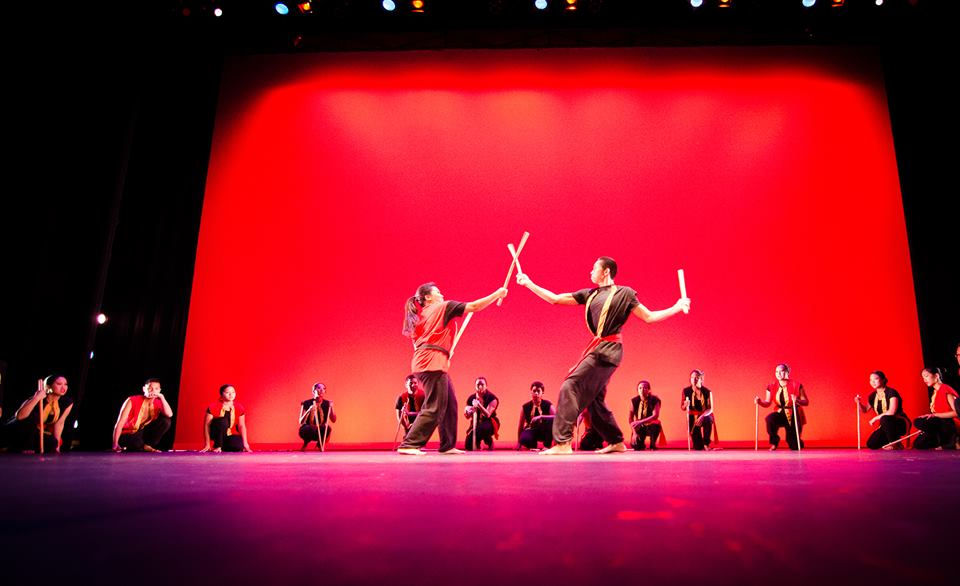
Kali is the ancient indigenous martial arts form of the Philippines. Kali is the mother term for escrima or arnis de mano, which are specified styles that developed in various regions of the Philippines.

A weapon-based martial art that utilizes wooden or rattan sticks, bladed weapons, and open-hand techniques, the fluidity and finesse of Filipino martial arts is seen by the precise geometrical movements that emphasize footwork, body positioning, and range and angles of attack.

The Script component combines the art of theater and musical theater to create an exciting, enlightening, and emotionally powerful performance.

Actors perform an original script which highlights the SPCN theme for the year, work to seamlessly transition the dances to fit within the story, and showcase the SP campaigns. Script aims to emphasize the issues faced within the Pilipin@/Pilipin@-American community as well as celebrate the community's numerous achievements.

Tinig ng SPCN highlights the beautiful gifts of voice and music, and provides a melodic and vocal way to express culture. The Pilipino culture is filled with music: from serenades and chants of times past to contemporary filipino music, melodic stories of love, family, and struggle are scattered throughout our history.


Through the Music component, Samahang Pilipino Cultural Night features original songs that are integrated with the Script and Dance components. Drawing from the show’s script and theme, our compositions serve to highlight each character’s unique place and universal struggles in the production. With the help of our gifted orchestra, actors, and choral suite (all composed of and run by students), the music we present expresses emotions that transcend the words and notes.

The people "behind-the-scenes" of SPCN, the components that comprise this portion include: Costumes, Financial, Webmaster/Historian, Aesthetics, and Public Relations.